Aging in America by Lawrence R. Samuel
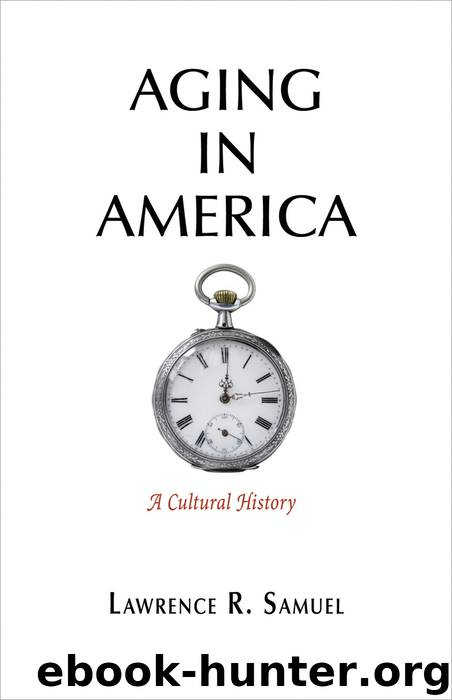
Author:Lawrence R. Samuel
Language: eng
Format: epub
Publisher: Langaa RPCIG
Published: 2017-04-16T04:00:00+00:00
Middle-Aging
The ongoing, concerted scientific effort to help solve what was still perceived as the problem of aging was in part a function of the growing concern about an older global population. The United States was hardly the only country that was graying, of course, as European and Asian nations confronted the future implications of fewer younger people and more older people. The United Nations had declared 1999 the International Year of Older Persons, in fact, a reflection of the aging that was taking place around the world. The year was being “celebrated in recognition of humanity’s demographic coming of age and the promise it holds for maturing attitudes and capabilities in social, economic, cultural and spiritual undertakings, not least for global peace and development in the next century.”27
Much as in other countries, government officials in the United States were primarily concerned about how a rapidly aging population would affect policy decisions that would have to be made in the decades ahead. Federal entitlements remained the heart of the matter, with no consensus as to how (or even if) they would be distributed when great numbers of baby boomers retired. Some, however, made the interesting case that predicting that aging boomers would bankrupt Medicare was, in a sense, anachronistic; major scientific breakthroughs would be realized before the majority of them were entitled to such benefits, this argument went, eliminating the need for costly care due to long illnesses.28 The debate over government entitlements aside, there was a consensus that boomers would require many more health care services than currently available. The U.S. Department of Labor was forecasting major growth for a variety of workers in occupations related to aging, including nurses, physical therapists, social workers, personal and home care attendants, and home health aides.29
The Department of Labor and baby boomers themselves were not on the same page, however. Aging in the present was hardly on their radar, much less that it would take place in twenty or thirty years. Some boomers did not even think the word “aging” applied to them; they preferred the term “middle-aging,” as it did not have the negative connotations that “aging” did.30 “This generation of ours refuses to believe it’s getting older,” said Betsy Carter, the editor in chief of My Generation, a new magazine from AARP aimed at fifty-to fifty-five-year-olds. The age of fifty was traditionally considered the end of middle age (and therefore the beginning of old age), but boomers were having none of that. Rather, the seventy-six million Americans born between 1946 and 1964 were adding years to middle age, to create what aging guru Ken Dychtwald called “middlescence.” “As they reluctantly migrate out of youth, boomers have already begun to engineer a new and vastly extended middle period of life,” wrote Dychtwald in his 2001 book Age Power: How the 21st Century Will Be Ruled by the New Old, seeing middlescence as a means of delaying oldness.31 “Boomers don’t do anything that is not cool,” remarked Helen Dennis, an aging and retirement
Download
This site does not store any files on its server. We only index and link to content provided by other sites. Please contact the content providers to delete copyright contents if any and email us, we'll remove relevant links or contents immediately.
| Africa | Americas |
| Arctic & Antarctica | Asia |
| Australia & Oceania | Europe |
| Middle East | Russia |
| United States | World |
| Ancient Civilizations | Military |
| Historical Study & Educational Resources |
Cat's cradle by Kurt Vonnegut(15356)
Pimp by Iceberg Slim(14508)
4 3 2 1: A Novel by Paul Auster(12393)
Underground: A Human History of the Worlds Beneath Our Feet by Will Hunt(12099)
The Radium Girls by Kate Moore(12028)
Wiseguy by Nicholas Pileggi(5786)
The Fire Next Time by James Baldwin(5446)
Perfect Rhythm by Jae(5404)
American History Stories, Volume III (Yesterday's Classics) by Pratt Mara L(5308)
Paper Towns by Green John(5191)
Pale Blue Dot by Carl Sagan(5008)
A Higher Loyalty: Truth, Lies, and Leadership by James Comey(4964)
The Mayflower and the Pilgrims' New World by Nathaniel Philbrick(4504)
The Doomsday Machine by Daniel Ellsberg(4490)
Killers of the Flower Moon: The Osage Murders and the Birth of the FBI by David Grann(4447)
The Sympathizer by Viet Thanh Nguyen(4390)
Too Much and Not the Mood by Durga Chew-Bose(4348)
The Borden Murders by Sarah Miller(4325)
Sticky Fingers by Joe Hagan(4199)
